Showing posts with label Bob Doran. Show all posts

Tuesday, April 1, 2014

News of Past Guests, April 2014 Edition

April 1st.  No foolin.  On NPR's A Blog Supreme today, Lara Pellegrenelli talks to guitarist Matt Stevens (who was just here with Linda Oh Sun Pictures) about his debut album, due out on Concord Jazz later this year. Stevens will also appear with his band on WBGO's The Checkout: Live on Wednesday, April 2 in a concert that will be webcast live (and archived) on NPR Music.


Drummer Rudy Royston (Tom Harrell Quintet, Miles-Versace-Royston Trio), whose new album 303 we noted back in January, is the subject of a feature article by John Murph in this month's Jazz Times.  And that DownBeat cover story on Ambrose Akinmusire we mentioned last month?  Now online.  Ambrose is also interviewed by Josh Jackson on the latest April 8th podcast of WBGO's indispensable The Checkout. (Meanwhile, drummer/bandleader John Hollenbeck [Claudia Quintet] appears with singer Theo Bleckmann on the April 15th edition of The Checkout, discussing their album Songs I Like a Lot.)


The uncategorizable new album of through-composed, Indian-beat-cycle-based, large-ensemble music by drummer Dan Weiss (David Binney, Rez Abbasi), entitled Fourteen, has appeared to rave reviews.

Also just out (on April 15th), the latest by Dave Douglas: Riverside, a collection of music inspired by Jimmy Giuffre, with Canadian brothers Chet and Jim Doxas and legendary bassist Steve Swallow (who played in one of Giuffre's trios).


Past (and future) RJA guests are well represented among this year's Jazz Journalists Association awardees: Joe Lovano took both the Multi-Reeds and Tenor Sax category, Anat Cohen won Clarinetist of the Year, Craig Taborn (Michael Formanek Quartet) was voted top pianist, and Regina Carter is primo--er, prima--among violinists.  Are we surprised?  Readers, listeners: we are not.

More RJA veterans on NPR Music:  saxophonist Chris Potter plays music from his ECM album The Sirens on JazzSet with Dee Dee Bridgewater, while pianist/composer/MacArthur Fellow Vijay Iyer is featured on WQXR's Q2 Spaces (in which contemporary composers are interviewed in their own homes and studios).

Finally: Humboldt's own Bob Doran has gotten around to posting his complete set of photos--great ones--from February's concert by the Omer Avital Quintet.  See for yourself:


Thursday, November 12, 2009

Bob Doran's Pics of the Ralph Alessi Show

Monday night's show with Ralph Alessi and This against That was another opportunity for Bob Doran to take another round of terrific pictures. He's a dab hand at a jazz study.

Check out the stream at Bob's Flickr site.

Tuesday, November 3, 2009

Bob Doran Interviews Ralph Alessi

Bob kindly sends us this very interesting interview with our next guest.

********************************************

A conversation with Ralph Alessi

The short bio on the website for trumpeter/composer/educator Ralph Alessi (www.ralphalessi.com) jumps straight to 1991, when he became "an active member of the New York jazz and improvised music scene as both sideman and leader."
He'd moved to the Big Apple from the Bay Area that year after growing up in San Rafael. His father was a freelance classical trumpet player who'd worked for the Metropolitan Opera and his mother was an opera singer before they relocated to the West Coast.

So you grew up in Marin County and left there to go to college?

I went to couple of different colleges and ended up at CalArts in Los Angeles. [Among his teachers was bassist Charlie Haden.] I got a couple of degrees there [in trumpet and bass]. And right after that I moved to New York.

What were you looking for in New York?

It was more of a feeling that I didn't have a choice. I had to move to New York because of the experience I had at CalArts; in particular I'd developed relationships and friendships, musical relationships with individuals like Ravi Coltrane, Scott Colley, Michael Caine, Peter Epstein and others. They'd either moved to New York before me or followed me out there. There was this feeling that it wouldn't make any sense to not continue what we'd started. And obviously there were other benefits to moving to New York, although I was a little reluctant at making that move. I was a little intimidated by the idea of living in New York, but I felt like I didn't have a choice, so I did it. And I'm still here.

When you moved there did you fall into the M-Base Collective?

I'd been a student of Steve Coleman at the jazz program at Banff [Canada]. Steve was one of the teachers there. About three years later he called me to play on an overdubbing session for one of his records. Then maybe a year after that I toured with him, and I continued playing with him for five or six years. But by that time the M-Base Collective wasn't really a collective any more. All those people were doing their own thing by that point.

Would you say the M-Base philosophy informed the way you evolved musically?

The M-Base Collective wasn't really a collective like the AACM [Association for the Advancement of Creative Musicians in Chicago]. The AACM had very defined tenants and ideas about what that was about. To my knowledge, the M-Base Collective was more just individuals who were playing together in those days. I was influenced by the music Steve was making and Greg Osby and others, but mostly Steve. I was into his music prior to meeting him. There's no doubt being around him and playing with him was important — he was a master musician. I was influenced by how he played, how he composed music, and also how he led a band. I liked his aesthetic for being a band leader.

Was he a model for the way you lead a band?

He's not the only one. Also there was the way Miles Davis led a band; Uri Caine is another who I played with a lot. It's basically hands off. You basically leave it up to the individuals, assuming that they will have the responsibility to learn the music and bring something to it. If that doesn't happen, then you call someone else. That's as opposed to 'You need to do this and you need to do that.' I'm more into leaving it up to the players.

So you present a composition and assume the players will make their own contribution to it?

Within reason. There are definitely moments where you want to be more active in the direction of the music, but I rarely do that. I call people that I know can bring something to the music in their own way. There's a process: You want people to bring forth their ideas instead of demanding immediate results. It's also about being accepting of different ideas rather than being rigid about your own ideas.

How do those ideas carry over into what you do as a teacher at the School for Improvisational Music? [the music school in Brooklyn founded by Alessi]

I would say that same kind of thinking is pretty consistent across the board. A lot of people involved [in the school] play with each other and they have shared sensibilities about how to play music, how it feels.

How do you teach improvisation? Is it something that can be taught as a process?

Sure, it can be taught.

How do you go about it?

First of all you have to inspire the students to investigate the music, investigate the vast resources that exist, especially nowadays. You learn so much just listening to recordings. I know that at least half of my own education was just listening, listening to all of the usual suspects, all the people what are part of the canon, the usual suspects being Charlie Parker, John Coltrane, Thelonious Monk, Ornette Coleman, on and on, Wayne Shorter, Sonny Rollins.
That music is just so rich; I continue to listen and learn from it myself. A lot of it is listening and being exposed to those ways of making music. The other part is encouraging people to play by ear, to play not so much from their intellect, but from what they're hearing, with more importance put on listening and ways of making music in the moment and the strategies that have to do with that.
Of course theory and harmony and things like that — the nuts and bolts of music — are part of the equation as well, but we deemphasize those things.

Didn't you initially learn music from your father?

I did. I took lessons from him for about 10 years, but in terms of the music that turned me on, it probably started with pop music of the day, but also my brother's record collection. It went from there. I really enjoyed playing the trumpet and I enjoyed how the trumpet fit into classical music, but eventually that kind of faded away as I had more experiences making music where you played more of an active part, as either an improviser or a composer. In particular the experiences I had at CalArts made it clear that I wanted to go in that direction. Once I moved to New York, I had made that commitment.

Do you think of yourself as a composer?

Not primarily, although improvisation is composition in real time.

You're a spontaneous composer...

In many ways. To me it's using the same creative energy. Both are very creative endeavors. So I guess I'm both an improviser and a composer...

And a teacher...

I enjoy teaching. I learn from it. It really gets you to think about your ideas in a deeper way. And I don't have a set way of doing it; a lot of times I'm improvising while I teach.

Friday, June 12, 2009

Gregg Moore and Bandemonium

Gregg has a new web site for all things Bandemonium.

http://relevantmusic.org/Bayside/Bandemonium/


"The Best in Human Powered Music for the Redwood Coast."


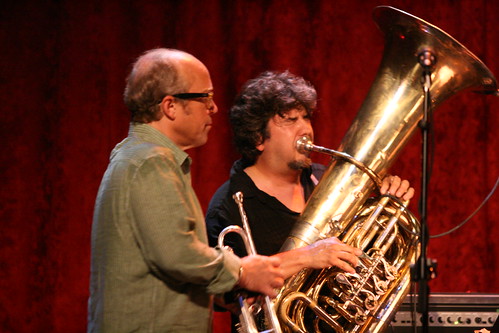
To see some really nice pics of Gregg and his tuba, visit Bob Doran's Flickr site and check out the photo set featuring Gregg.

Thursday, March 12, 2009

Uri Caine talks to Bob Doran

The Uri Caine Interview (for the North Coast Journal, conducted by Bob Doran)


You seem to have a lot of projects going.


I do. I have different things happening.


I've been listening to your Live at the Village Vanguard album, thinking what you do is basically straight-ahead jazz. Then I took a look at the discography on your website and realized that's just one aspect of what you do. You seem to be musically omnivorous.


No, it's just a sequence of things. Musicians who grew up with a lot of different kind of music — and also if you're a keyboard player — you get a chance to play a lot of different styles of music. That's what I did when I was younger, which was a good way to start thinking about different ways of playing.


Different like your more electronic band, Bedrock...


Exactly. And sometime it's taking classical music, using it as a basis for improvisation playing with an ensemble. A lot of that is based on some of the CDs I've made, using those [pieces] as a basis for improvisation. And I play with all different types of improvisers. I've been doing that pretty much since I started playing music. But as I said before, playing keyboards has a lot to do with that — it's versatile. Looking back on the strong musical experiences I've had, everything from playing with singers and playing with choirs to playing different styles of jazz, free music, more swinging stuff, I've tried to get in touch with all of it.


It's omnivorous in contrast to other musicians who might focus more on just one style.


That happens in all types of music and art. For me, it's not just eclecticism for its own sake; it's more just moving from one opportunity to another. Playing swinging music is a different challenge from playing with an orchestra, or learning how to record yourself on a computer. You work on all those things. I think it's good also to have a wide variety of composition styles. In some cases you need something quite specific, other times you need something loose and open.


When it's more or less spontaneous composition...


Exactly. Or you set certain guidelines, underlying things that happen in each piece to set a structure for improvisation.


So while you describe yourself as a composer, sometimes that only means providing a framework.


Depending on the situation, you might have a group of musicians where some are reading and others are improvising or everybody is improvising over a certain chord change. Sometimes you create different sections within a piece by setting who's playing and who is not. Again, that comes from my experience. When I was growing up I was playing more straight-ahead jazz, bebop influenced, but at the same time I was working with people who were more into freer compositions.


Weren't you also studying composition with established modern composers?


That's right. I was lucky. When I was a teenager, I was studying with a composer in Philadelphia, George Rochberg. He was teaching a parallel course where we would go through a lot of classical forms. We'd write in forms like a Mozart sonata or a Beethoven development form. He had been known more for serial atonal work, but he'd switched back to more tonal styles and doing collage music that had snippets of other people's music. In academic circles that was considered radical.


Do you think we've reached a point in music where you don't expect that sort of reaction, where pretty much anything goes?


There's certainly more tolerance, allowing different styles to coexist. Especially today there's this information overload: You can sit and listen to music from Bali, then Beethoven, then to what was once obscure contemporary music or obscure electronic music — you can find it all. That tends to even things out. Everything becomes everything. But I think back then in the academic world coming out of the '50s and '60s, there was this thinking that there had to be a strong theoretical influence from contemporary music to be taken seriously, Arnold Schoenberg etc. etc.


What does it take today to be considered seriously?


A YouTube page.


Or a MySpace page.


Right. That's what I mean. The context is changing. I think it's a good thing for musicians. The whole idea of ownership of music and making money from music that way has changed.


It's hard to say what the new music business model will be if everyone can get music for free.


One of the things it does for performers is, it makes the performance more of an avenue. That's not touched the same way. People still want to see live music.


What's your deal with your recordings? It seems like you have a lot of liberty.


I record a lot for a record company based in Munich. It was Jazz Music Today, then it became Winter & Winter. They've made about 19 of the 20 or so CDs I've done.


Is it safe to assume you have relationship where they let you record whatever you want, up to a point?


Some of the music I've wanted to do is harder because it's very expensive, especially the more classical things with orchestra. You have a lot of musicians to pay. But most of my stuff was done through him.


What do you have in the works?


I'm making a new Bedrock CD, so we are editing that now and also working on building computer grooves. We're trying to get a certain rhythmic sound in editing on the computer. We looking for a certain spaced out sound, so that involves either working on what we've done and playing over it, or going in the studio then deconstructing it.


And in the middle of that you're shifting gears to work with a trio playing straight-ahead. Does that require realigning your thought patterns in some way?


No. Especially with our group because we've been together so long. We're used to playing with each other, so it's just natural. In that group we're mostly playing standards and originals, but there's also an open aspect to it. Things can go into different fields or grooves — we try not to play things exactly the same way. After working for days trying to construct something like what we do with Bedrock, it's actually a relief to go out and just play. You're free. You're not second guessing. You're just going for it. It's also different from this other thing I'm trying to finish, a piece for string quartet. The goal there is to create a piece that has space for improvisation but also a structure. That's also hopefully to be recorded in spring. All these different things make you think in different ways.


I see on your website that your record The Othello Syndrome was nominated for a Grammy for "Classical Crossover." What is that? I'm not sure I know what it means.


I don't know what it means either. I'm not really trying to do that. You have no control over how people interpret what you're doing. You just do it and hope that it's OK.

Saturday, December 22, 2007

RJA Top Six

Here's a Top Six. You'll find this list published in Bob Doran's column (The Hum) in this week's Northcoast Journal:


The Redwood Jazz Alliance folks sent a Top 10 jazz albums list that was really 12. Here are five (well, six).

No. 1, a tie: Song for Anyone — Chris Potter 10, and Follow the Red Line: Live at the Village VanguardChris Potter Underground. The former is chamber music-like, with flute, clarinet, bassoon and a string trio. The latter is funk- and rock-influenced postbop with a bass-less quartet. What they have in common is Potter’s brilliant improvisations on tenor and soprano saxes and bass clarinet.

Sky BlueMaria Schneider Orchestra. Her greatness as a composer became apparent a couple of CDs ago. This disc is filled with music that’s lovely at first listen and grows increasingly rich and deep with repeated hearings.

The Words and the DaysEnrico Rava Quartet. One of the giants of post-Miles trumpet playing, Rava has been dubbed “Italy’s gift to jazz.” Lively, gorgeous music from an all-Italian group.

Pilgrimage — Michael Brecker. On his final recording, the late great tenor saxophonist gets some old friends (H. Hancock, B. Mehldau, P. Metheny, J. DeJohnette) to play all-star sidemen for an album of urgent, swinging originals.

Big PictureTrio M (Myra Melford, Mark Dresser, Matt Wilson). These three share much more than an initial. Terrific composers and brilliant players all, their interplay is what really makes this album shine.